

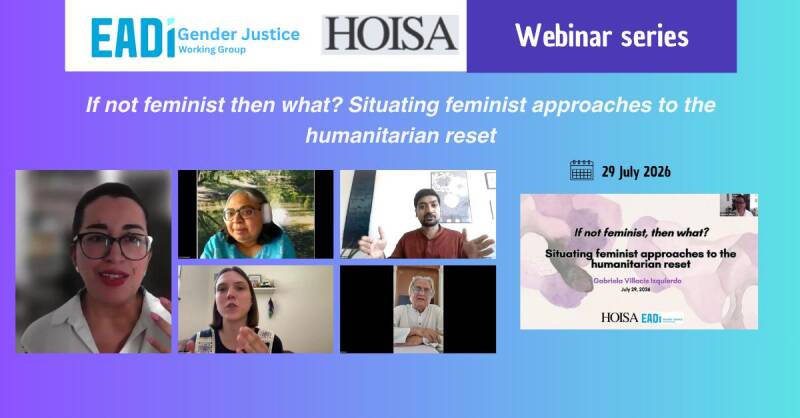
Yesterday, we had the last webinar of the season (before a well-deserved summer break 🌻), a joint collaboration with the Humanitarian Observatory in South Asia (HOISA). Special thanks to all of you who joined from different parts of the world.
With the title "If Not Feminist, Then What? Situating Feminist Approaches to the Humanitarian Reset", the webinar enabled a rich conversation on feminist approaches to humanitarian action, bringing together voices from Colombia, Ecuador, India, and beyond. Gabriela Villacis Izquierdo (ella/she/her) opened with findings from her five-year doctoral research in Colombia, arguing that the everyday, relational, and community-embedded humanitarian work happening outside formal international structures is often more sustainable and transformative than top-down responses.
Catalina Domínguez built on this with concrete examples from Colombia, describing how women's leadership emerged as men were displaced, recruited, or killed by conflict, and how feminist and women-led organizations have driven gender-based violence protections into formal humanitarian architecture, often without being formally seated at the decision-making table themselves.
Swarna Rajagopalan brought feminist politics into formal humanitarian work, framing it around three entry points: vulnerability, visibility, and voice, asking who is vulnerable, why, and what systemic fixes are needed rather than treating vulnerability as fixed or singular.
Mihir Bhatt closed the panel with a clear call to action: begin with women's knowledge, share power and resources, recognize care and livelihood as inseparable from humanitarian response, and build accountability that asks not just how much aid was delivered, but whether women felt safer, retained control over resources, and saw their organizations strengthened.
The panel's shared conclusion was blunt and hard to argue with: a feminist humanitarian approach doesn't simply add women to an unchanged system, it changes the system itself. There can be no humanitarian justice without gender justice; they are not two separate goals, but the same one.
We would also like to extend our gratitude to Khayal Trivedi for the panel's organisation and great moderation.
Add comment
Comments